
By award
Honours and Awards
The British honours system recognises merit, achievement, and service across every walk of life - from public service and the arts to medicine, science, sport, and community work. Honours are conferred by the Sovereign, twice a year, on the New Year and the Sovereign's Birthday, alongside operational and gallantry awards announced throughout the year.
This directory describes the 32 honours, orders, medals, and awards currently recognised within the system. Each entry sets out the award's purpose, eligibility, rank and precedence, entitlements, and significance.
The register
The honours system
Every honour in the Honoria honours vocabulary. The orders of chivalry appear in the order of wear, most senior first, with each order’s grades in precedence order; the decorations, medals and awards conferred outside the orders follow. Open an entry for its eligibility, entitlements and recipients.
Orders of chivalry
The most senior order of chivalry in the United Kingdom, founded around 1348 by King Edward III and in the personal gift of the sovereign; members are styled Knight Companion (KG) or Lady Companion (LG).
The senior order of chivalry of Scotland, revived in 1687 and in the personal gift of the sovereign; members are styled Knight (KT) or Lady (LT).
A British order of chivalry founded in 1725 by King George I, with military and civil divisions, awarded principally - though not exclusively - to senior officers of the armed forces and senior civil servants. Its grades are GCB, KCB/DCB and CB.
An order founded in 1902 by King Edward VII, in the personal gift of the sovereign and limited to 24 members, recognising exceptional distinction in the arts, learning, sciences and other fields; post-nominal OM.
A British order of chivalry founded in 1818, awarded chiefly for service in foreign affairs, diplomacy and the Commonwealth. Its grades are GCMG, KCMG/DCMG and CMG.
An order of chivalry founded in 1896 by Queen Victoria, in the personal gift of the sovereign, rewarding distinguished personal service to the monarch. Its grades are GCVO, KCVO/DCVO, CVO, LVO and MVO, with the associated Royal Victorian Medal.
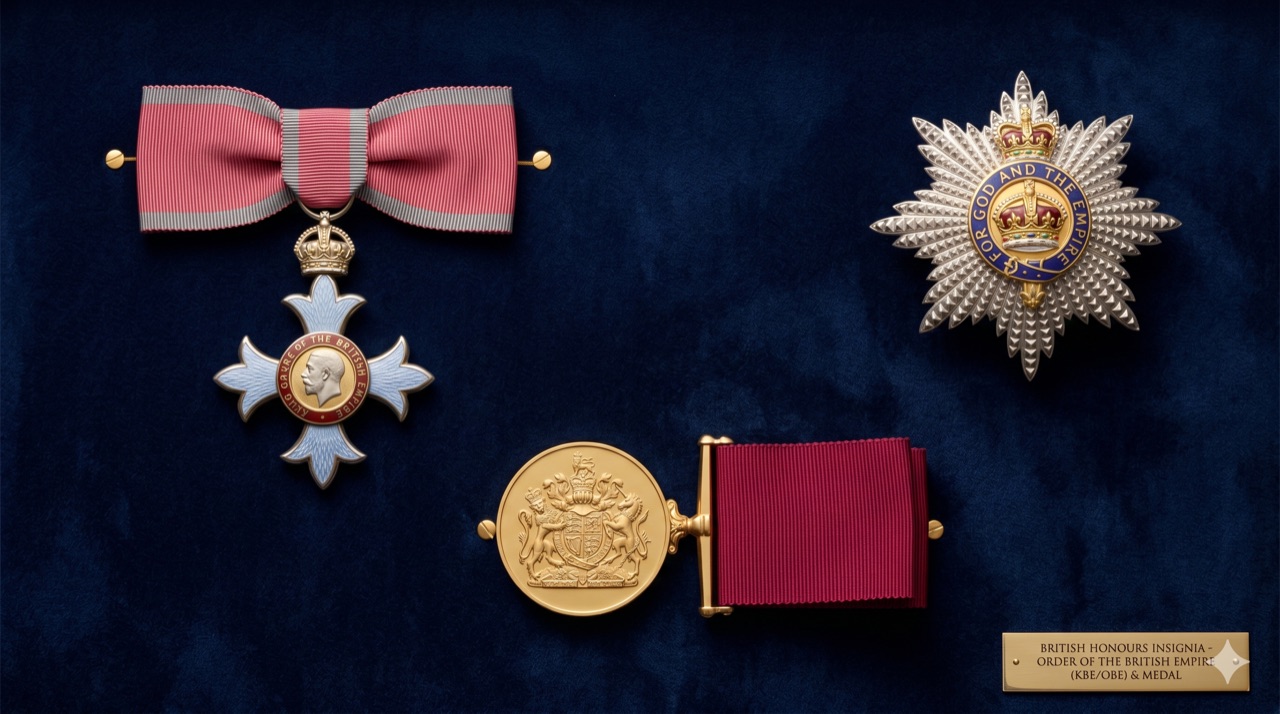
A British order of chivalry established in 1917 by King George V to recognise distinguished service in the arts and sciences, public life, and charitable and welfare work. Its grades, in descending order, are GBE, KBE/DBE, CBE, OBE and MBE, together with the associated British Empire Medal.
An order founded in 1917, limited to 65 members at any one time, recognising outstanding achievement in the arts, science, medicine, politics, industry or religion; post-nominal CH.
Beyond the orders
Gallantry and bravery
Decorations and medals for acts of gallantry and bravery, led by the Victoria Cross and George Cross.
Distinguished and meritorious service
Decorations for distinguished service in the armed forces, the civil service and nursing.
Service medals and awards
Medals and awards for the emergency services, the volunteer reserves and voluntary service.
Military honours
Honours for the armed forces
Many orders, including the Order of the Bath and the Order of the British Empire, are awarded in a Military Division, alongside dedicated gallantry and service medals. Recipients are gazetted with their rank and service branch. Browse the men and women of the Royal Navy, Royal Marines, Army and Royal Air Force recognised in the honours.
Explore military honours